
Ready to test your knowledge?
How would you prune the trees shown below? Click to reveal the answer!
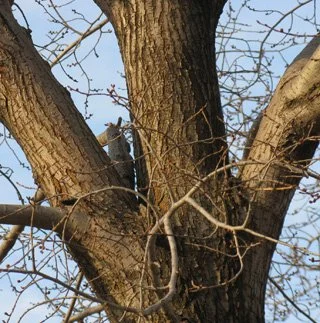
The large stem to the left has an inclusion in the union and is poorly connected to the trunk. The branch on the right does not have an inclusion. Both are growing very aggressively judging by their large size relative to the trunk. Reduce the length of the left stem by about half, or more. Reduce or thin the branch on the right by a third to a half.
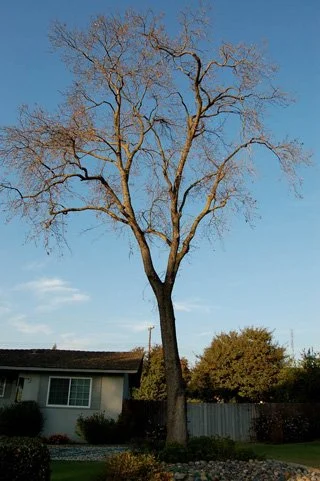
This tree has good structure until half way up the trunk where it forks into two equal-sized, codominant stems. Stems of equal diameter are not as well connected as when one is considerably smaller in diameter than the other. If there was a bark inclusion in the union, both stems might be reduced and thinned toward the top of the crown. If there was no inclusion, then one side could be reduced. Lateral branches in the lower and mid-crown do not appear to require any treatment at this time.
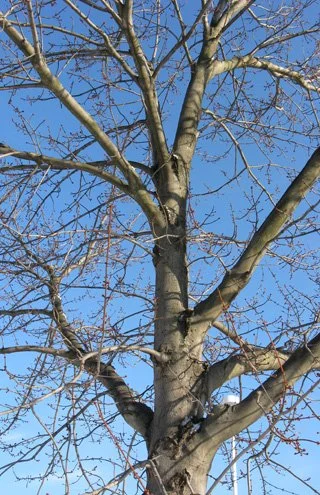
This tree has reasonably good trunk and branch structure. Four main branches are grouped or clustered together in the bottom of the crown. If these were left alone, they often grow aggressively to eventually choke off resources to the leader. The largest two or three of these could be suppressed by either thinning or reducing them to allow the leader to maintain dominance. There are two fairly large branches very close to one another about two-thirds the way up the crown. Both of these should not be allowed to grow unchecked because they are likely to grow into each other as they increase in diameter and form an inclusion in the union. One should be reduced, thinned, or removed now.
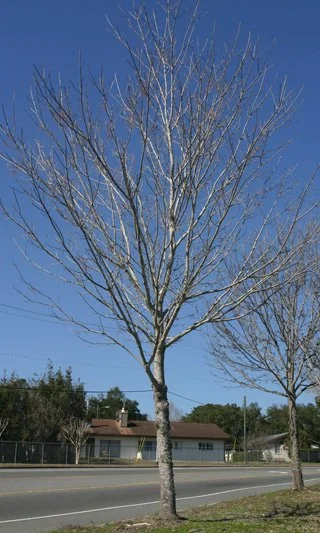
There is a leader technically all the way to the top of the tree. However, it soon becomes very small once it extends up into the crown a few feet. At that point, many branches emerge which take resources away from the leader which suppresses growth in the leader. In order to re-establish the leader's dominance, remove some of the branches at the trunk in the lower third of the crown. Others may be reduced in length using reduction cuts. One or two stems competing with the leader may need to be removed from the very top of the tree
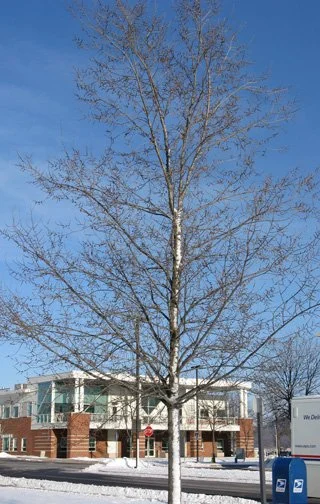
Architecture is excellent in the bottom half of the tree indicating that the nursery did a great job developing a dominant central leader. The tree divides into two equal-sized stems about half way up the crown, and then each of these soon divides again. The result is four apparent stems in the top half of the crown. The origin of these was at the position of the tree top when it was planted. Two very young, perhaps only one-year-old, stems were present at the time of planting. If one of these 12-inch-long stems would have been removed at planting, two stems probably would not have formed at this point.
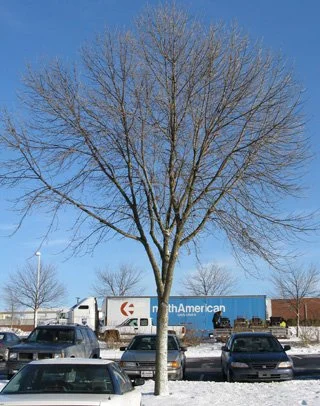
Architecture is poor and prone to failure. The tree has committed tremendous resources into growing three codominant stems originating six feet from the ground. Choose the stem in the center as the leader and reduce the height and length of the right and left stems. Several pruning cuts may be two to three inches diameter may be needed on each stem.
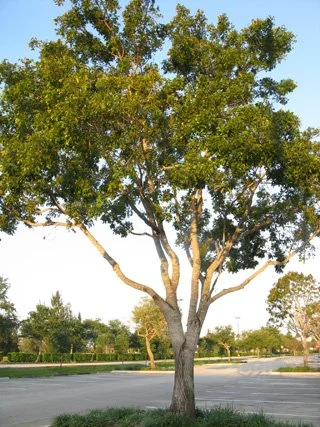
Architecture is poor and prone to failure. The tree has committed tremendous resources into growing two codominant stems originating five feet from the ground. Choose the stem on the left as the leader and reduce the height of the center portion of the crown that is connected to the stem on the right. Pruning cuts may be two to four inches diameter.
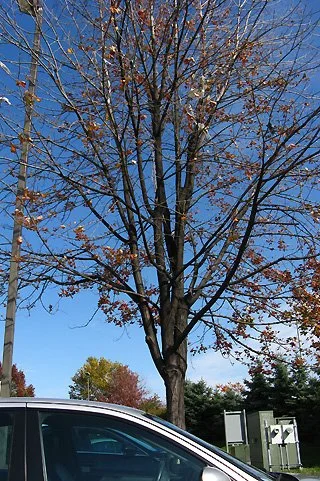
Tree architecture is terrible. Three main stems about five feet from the ground dominate the crown and are growing parallel to one another which makes correction very difficult. One option would be to reduce the tree and keep it at a reduced size in perpetuity.
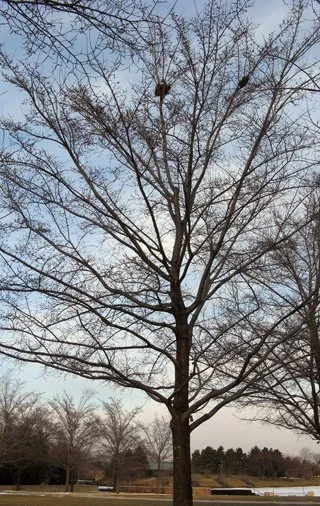
Structure in the bottom half of the crown is great. There is one trunk extending well up into the crown and branches are small in diameter and oriented more-or-less horizontally. At mid-crown, a few branches are growing more upright. There are several branches and stems in the top half of the crown growing upright and almost parallel to each other. Stems and branches growing upright can be subordinated or suppressed by reducing their length with reduction cuts where possible. Retain one upright as the leader.
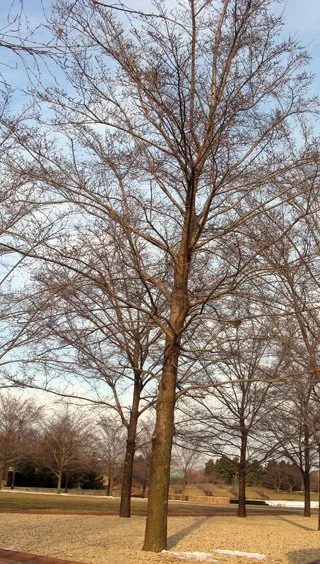
Structure in the bottom two-thirds of the crown is great. There is one trunk extending well up into the crown and branches are small in diameter and oriented more-or-less horizontally. There are several branches in the top half of the crown growing up and almost parallel to each other. Stems and branches growing upright can be subordinated or suppressed by reducing their length with reduction cuts where possible. One or two might be removed entirely and one retained as the leader.