
Reducing the Crown
Unlike a removal cut, reduction cuts back to a weak natural boundary resulting in internal wood discoloration and decay behind pruning cuts, especially in weak compartmentalizers, in drought, or in trees in poor health. Although reduction cuts are preferred when reducing crown size, heading cuts are sometimes necessary. Crown reduction can lead to dead bark on top of retained branches from sudden sun exposure; this is very damaging to trees. For these reasons, it is best not to reduce the entire crown if at all possible, especially on mature trees. However, reduction is a useful pruning method which has many applications, especially when applied to selected portions of the crown for specific objectives. For example, it is a useful means of retaining very old trees. Trees have endured crown reduction since arriving on the planet having been reduced in size as they break in storms.
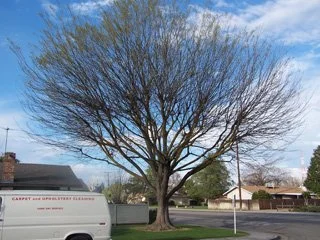
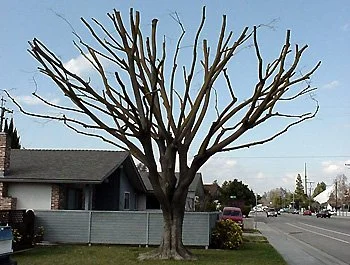
The objective is to make reduction cuts so lateral branch tips remain intact on the outer edge of the new, smaller crown (right photograph). Ideally, pruning cuts should be hidden and the crown periphery should look a bit jagged.
A word of caution:
Resist the temptation to create a smooth crown outline by pruning retained lateral branches because these are destined to become the main branches on the new, smaller crown. Heading (topping), shearing, tipping, lopping, or rounding-over are considered substandard techniques for reducing the size of a shade tree because they compromise the tree’s structure. If more than twenty-five or thirty percent of the foliage will be removed on anything but a young tree, consider dividing the job into two sessions, one growing season apart, to minimize starch (energy) removal and stress-induced sprouting.
Reducing the crown should not be used to bring down the size of trees of large diameter. This is called topping and is not recommended because it damages trees permanently. Heading large-diameter branches causes many problems including massive decay in many species, weakly attached sprouts, and many dead branch stubs. Topping occasionally kills trees. If a tree needs regular pruning to keep it small, perhaps the wrong tree was planted in that location. Consider replanting with an appropriately sized plant, or else move the obstacle you were pruning the tree away from and structurally prune to develop strong structure.
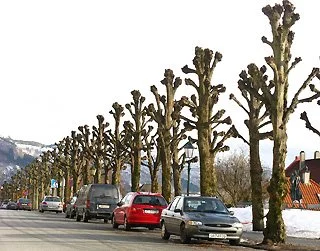
Maintaining old trees
Examples of pollarding which maintains trees at the same height forever. New shoots are removed back to the same point, the pollard head, annually. Trees in the photograph are 140 years old.
Reduce breakage risk
Case 1:
The enormous limb with two large cracks (second limb from the ground on left side of tree) is very weak. The closeup shows both cracks clearly. This limb is a good candidate for reduction which should reduce the likelihood of the branch breaking.
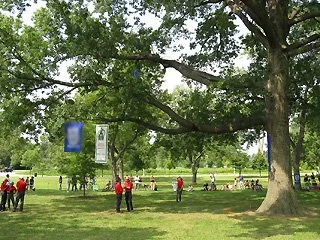
Huge limb with severe crack
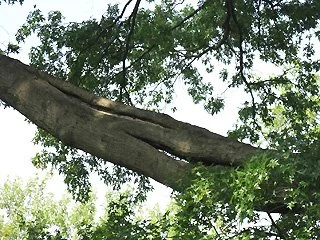
Closeup shows two large cracks
Case 2:
The tree forks into two codominant stems about five feet from the ground. The entire tree needs to be reduced to help prevent the tree from splitting apart. Only the left side of the crown was reduced in the right photograph. The right side of the crown also needs to be reduced.
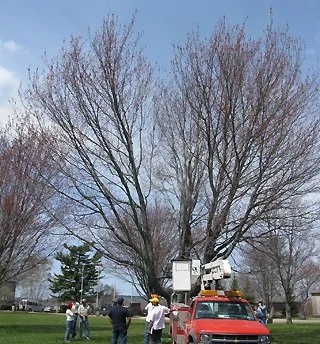
After reducing the left side of crown only
Before reduction